07
DEC
Q & A: An Interview with Elizabeth Claflin
BY ELLA COLMENARES
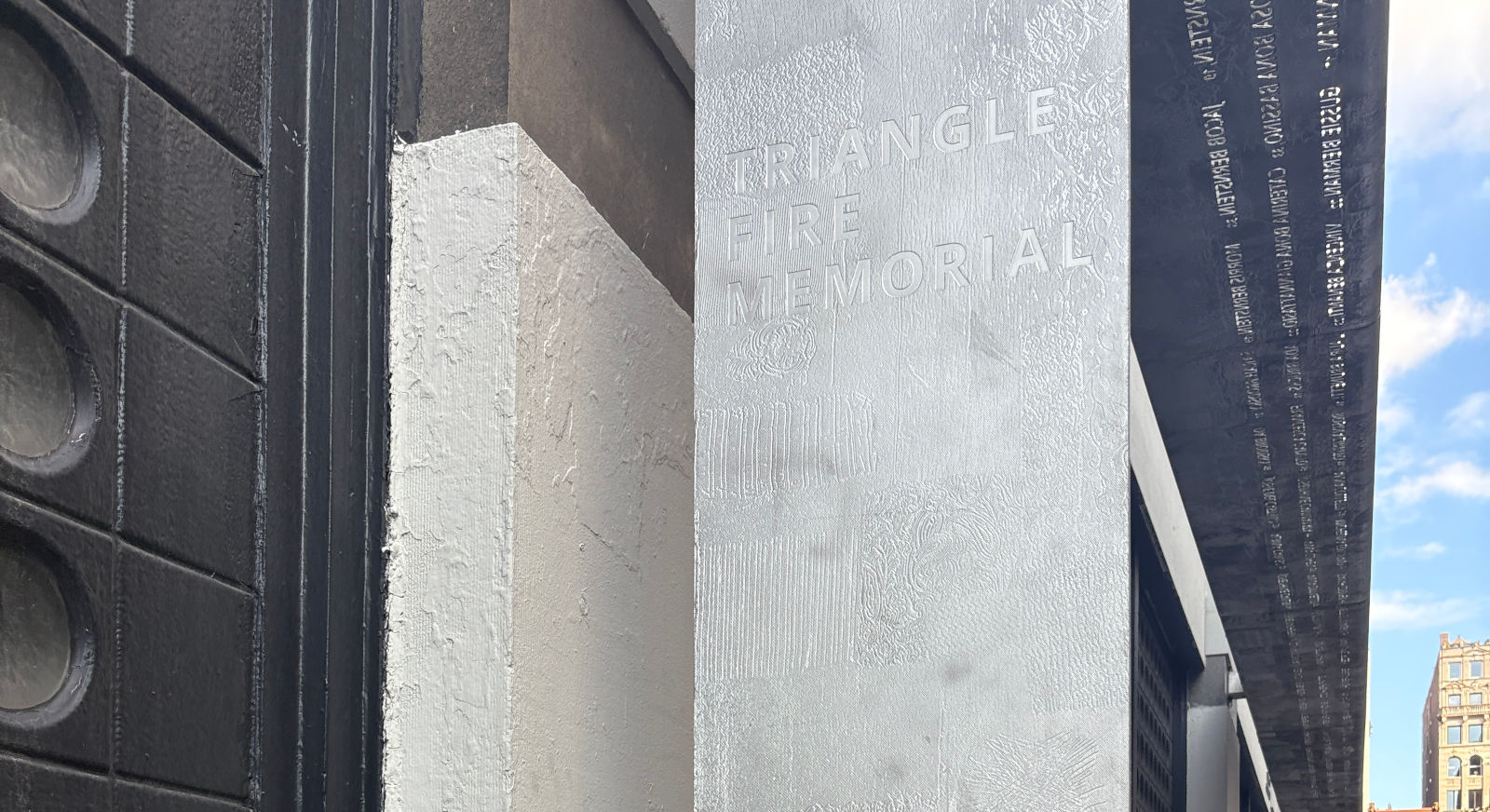
New York City bustles with tourists and tour guides visiting sights of historical landmarks, joyous and tragic, leading some of them is Elizabeth Claflin. The actor-historian is well-acquainted with the memorials of NYC, including the Triangle Shirtwaist Factory Fire Memorial, which we visited with her in August of 2025. Attached to what is now New York University classrooms, the memorial reflects the names of Factory Fire victims as a ribbon of fabric-etched metal spirals down from the top floors where the fire was started. For tour guides like Claflin, the memorial comes with a wealth of knowledge and stories of the workers who lost their lives. I reached out to Claflin to learn more about what it is like to give a tour of a site of mass casualty event.
Seeing the Triangle Shirtwaist Factory Fire Memorial made me realize how young and interconnected the victims’ lives were. When you were working on this tour, what was it like to learn about the victims and their individual stories?
When I was working on creating the tour, I realized I never really connected to the individual stories. I'd been talking about the events of that day for years but always as part of a Greenwich Village tour, so I never realized how generalized the event had become for me. For (IHP Death and Dying), I was really glad to research more of the individual stories, focusing on one event rather than an entire neighborhood made me connect so much more to the people of the event. The age of the victims is one of the most heartbreaking elements of the story. Today, we can't fathom the idea of a fourteen year old working in a factory full time but back then, it was perfectly legal and common. But the fact that the overwhelming majority of the victims were young immigrant women strikes people today just as it did back in 1911. It's part of the reason why we never had a worst factory fire in this country, the event was so tragic that it actually made people in power make the necessary changes to one of the most valuable industries in the city. One the stories that has really stuck with me since (IHP Death and Dying’s tour is) that I have added into many of my tours was that of the elevator operator, Joseph Zito. His story is often overlooked, but he is one of the heroes of that day. One of the other stories I often use in my tours that sticks with me is that of Rose Freedman who survived because she knew to follow the executives, that they- of all people, would know how to get out of the building alive. Knowing those stories helps me understand the events of the day so much better.
If you connected to their stories, did that connection impact your life, how you think about the Fire, or even that particular block in NYC?
One of the personal connections I have made with the building over the years is similar to the account made by Francis Perkins who witnessed the event live, she watched women and girls her age and younger literally jump to their deaths to escape the flames. I have never worked in a factory but as I tell the story as a woman, it's easy to imagine myself among them. As for the block itself, it has changed so much since the memorial was installed. When I first started giving tours, there were only a few plaques that referenced the event. There were other things that happened in the building and on that block, of course, but it seemed to me as if the city and university did not want people to think about the fire so much. Now there is no escaping the event, it will be a permanent reminder that even though the name of the building has changed, even though it's full of classrooms instead of sewing machines, what happened in 1911 was incredibly important and should never be forgotten.
I’m a tour guide at my university and sometimes it’s difficult to keep personal emotions out of my answers and my tour; how do you separate your emotionality when The Triangle Factory Fire was such a tragic event?
I believe as a tour guide that our own impulses, interests, and emotions impact the tour we are able to provide. I always think that if it's interesting to me, it'll be interesting to other people. That particular stop has occasionally brought my guests to tears so I find they tend to get more emotional than I do. I have also found my 9/11 memorial tour also brings that out of people. For myself, I don't usually get too worked up while giving the tour, I get more emotional when I'm doing the research. I also have a background in acting so I think that helps me to connect to my emotions as much as it helps the tour, but I can stop myself if I'm getting too worked up or if I feel like a guest is getting too upset.
How do you decompress after giving a tour about a tragic, preventable event?
After a tour like Triangle Shirtwaist or 9/11 memorial I usually try and find a nice distraction. Since I moved to the suburbs, I find my train ride home helpful, I can relax and decompress and look at the view. It's something that I've gotten better with as I've gotten more experienced. I also think the "preventable" part of (the) question is important. When I have political discussions about tragic and unnecessary things that happen today, I always keep historical events like this fire in mind. People take for granted a lot of the workplace requirements that were implemented because of the Triangle Shirtwaist Factory. It's also important to note that those victories were not easy, factory owners and people invested in the garment industry fought these changes tooth and nail but history has shown that they work.
What would you want to say to a Triangle Fire victim’s descendent about the memorial? What would you want to ask or know?
I would want to ask a descendent of a survivor or victim how the fire still impacts their family story today. I can only imagine that every family would have a different answer to that question. Sometimes people pass the story and legacy down to each generation while others, because of the trauma, choose to not speak of it at all. I'm sure there are so many people that have no idea that they are connected to such a well-known event.