





Death in New York City: Landscapes, Relationships, and Power Structures
New York City, USA
Asher Donnelly
Our week in New York City studying death was an excellent exercise in connecting the disjointed. We pushed forward with the momentum of tumbling down a bumpy hill, catching leaves in our hair and finding hidden pine needles in our pockets for days after. Don’t let this description give you the wrong idea. I greatly enjoyed the fall.
Photo Captions
- Photo 1 - Currated Landscapes - The orderly lines, uniform symbolism, and artificially curated landscape of Calvary Cemetery and/or the beauty, splendor, and glory of Calvary Cemetery.
- Photo 2 - Currated Landscapes - Gravestone peacefully tucked into ivy at formerly abandoned Richmond Terrace Cemetery and/or ivy obscuring and strangling gravestone at Richmond Terrace Cemetery
- Photo 3 - Currated Landscapes - Graves peaking their heads over rolling waves of greenery at Trinity Church Cemetery
- Photo 4 - Currated Landscapes - Tombs, hot dog carts, and cars at St. Paul’s Chapel Cemetery
- Photo 5 - Currated Landscapes - Skylines of the living and dead at Green-Wood Cemetery
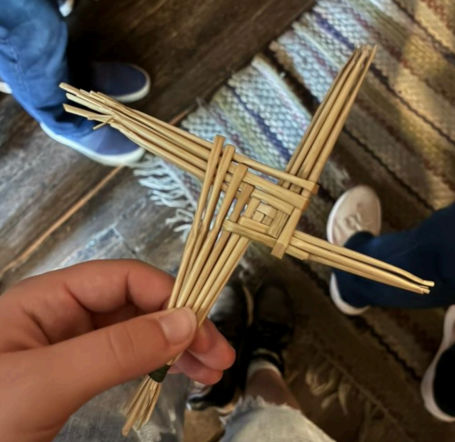
- Photo 6 - Continuing Bonds - St. Brigid's Cross woven from straw at the Tenement Museum.
- Photo 7 - Continuing Bonds - Richmond Terrace Cemetery before and after restoration
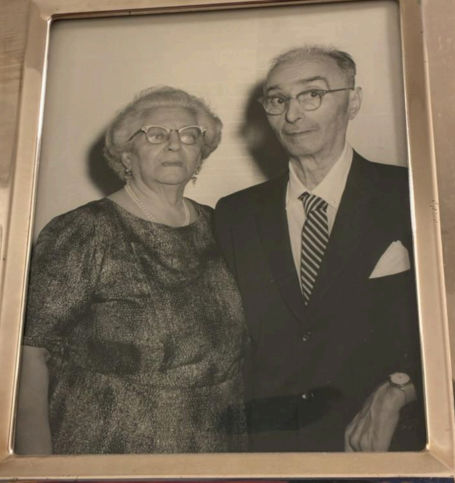
- Photo 8 - Continuing Bonds - Photo of my great grandparents hanging on the wall of my relatives house where I stayed the night before our program began
- Photo 9 - Death in Societal Structure - Triangle Shirtwaist Factory Fire Memorial
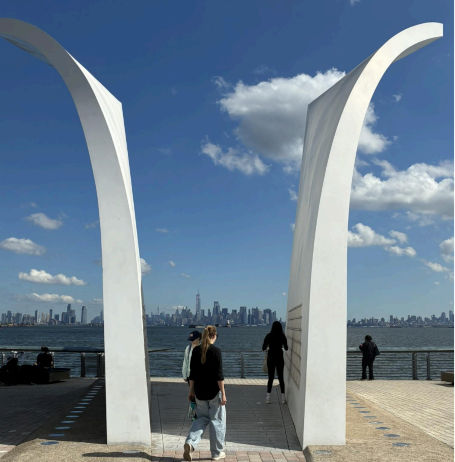
- Photo 10 - Death in Societal Structure - The Staten Island September 11th Memorial
- Photo 11 - Death in Societal Structure - African Burial Ground Monument
- Photo 12 - Final Image
Death in New York City: Landscapes, Relationships, and Power Structures
Our week in New York City studying death was an excellent exercise in connecting the disjointed. We pushed forward with the momentum of tumbling down a bumpy hill, catching leaves in our hair and finding hidden pine needles in our pockets for days after. Don’t let this description give you the wrong idea. I greatly enjoyed the fall.
One of the first coherent ideas I had that week was a comparison of Calvary Cemetery and the formerly abandoned cemetery on Staten Island. It came from an observation of how much more comfortable I felt at the formerly abandoned cemetery compared to Calvary. Calvary felt so exposed, harshly lit by direct sunlight from an absence of trees. The air felt stuffy from the smell of nearby highways and recently mown grass. The formerly abandoned cemetery felt inviting with a soft floor of fallen leaves and shadows shifting in and out with the wind. After noticing this personal preference my train of thought flipped to entertaining alternative perspectives. I considered that others likely appreciate the meticulous care put into the upkeep of Calvary and may find the formerly abandoned cemetery depressing, undignified, or even creepy. Each person entering these spaces experiences their sensory features differently, resulting in varied emotional responses shaped by personal associations and understandings of the meaning of cemeteries.
The first section of my collection of photos highlights the different landscapes and environments of the cemeteries we visited. The photos depict grasses, trees, and vines that shape the cemeteries’ grounds set against backgrounds of skies, streets, buildings, and greenery. These are underlying elements of cemeteries that give rise to peoples’ assortment of thoughts and experiences of them. Is it disrespectful or beautiful for gravestones to be nestled into a sea of grasses? Is it insulting to let a graveyard sit beside food carts and noisy traffic or is it an honor for the dead to lay beside the ongoing change and development of a city? These photos encourage people to consider how their embodied connection to landscape and place guides their internal experiences and to reflect on the many interpretations that lay in these resting places.
My photo essay then considers the ways we bring ancestors close across time and space into our present lives. At the Tenement Museum, we were offered a window into the world of immigrant families on the Lower East Side, who journeyed from far distances and left much of their lives behind. The woven St. Brigid’s Cross, kept in a doorway to protect a household, was a small yet important symbol that preserved tradition. I return to the photos from the abandoned cemetery project here to highlight the moving story of Lynn Rogers, founder of Friends of Abandoned Cemeteries of Staten Island. Her realization that she could not visit her grandparents’ graves compelled her to restore the cemetery, ultimately preserving the stories and histories of dozens of others. I also include a photo hanging on the wall of my relatives’ house of my great-grandparents, who immigrated from Romania. I continue to wrestle with the question of how to honor and remember my own family when I feel like I know very little and there’s not always the space to ask.
My final selection of photos considers how deaths on a mass scale are memorialized. I display the structures that commemorate the Triangle Shirtwaist Factory fire, the September 11th attacks, and the African Burial Ground project. Each of these tragedies is remembered in distinct ways, shaped by different historical and political circumstances. The Triangle fire and the African Burial Ground were only recognized through sustained protest and community organizing while the September 11th attacks were memorialized almost immediately with significant government and financial support. This contrast also reveals a broader difference: while the state engaged in direct political action following 9/11 with the purported aim of seeking justice, the burden fell to citizens to fight for safer labor conditions in the wake of the Triangle fire and to preserve the histories of those laid to rest at the African Burial Ground.