





Death, The Great Equalizer?
New York City, USA
Ella Colmenares
In the US there is an expectation that death is an equalizer -- something to conquer socioeconomic imbalance, racial disparities, gender divides, any manner of life’s tribulations. However, our review of death in New York City revealed that while death is a certainty, it does not occur equally nor are the dead remembered with equal respect and care. This photo essay explores the tension between death markers and how society has valued them over time -- examining their upkeep and the design of the markers themselves.
Photo Captions
- Photo 1 - Drive-by Death - The Cavalry Cemetery houses 3 million of New York City’s dead. Some of whom now have a front row seat to morning traffic as city expansion means the cemetery is surrounded by warehouses and roads.
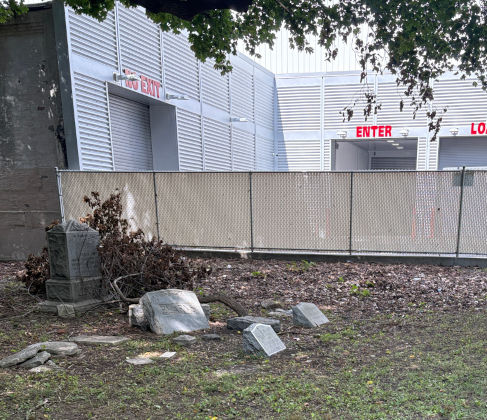
- Photo 2 - Interrupting Timelines - Sections of the Richmond Terrace Cemetery are seemingly in danger of being erased by modern buildings with headstones wilting into the earth, erasing any trace of the person they remember. Meanwhile, industrial life bustles on just beyond a flimsy chain-link fence.
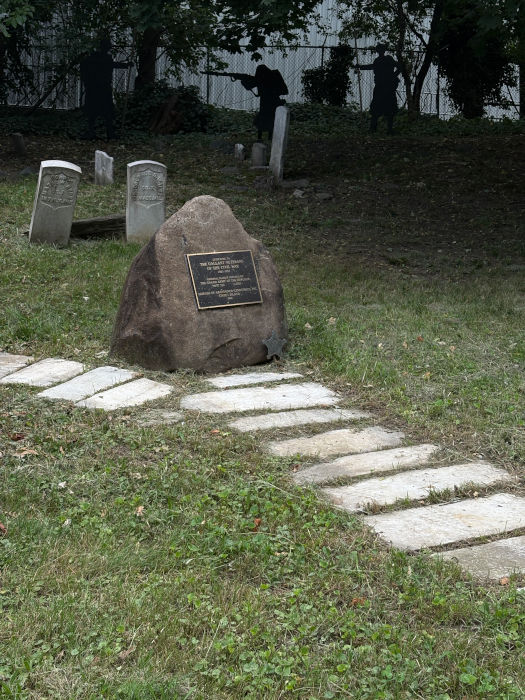
- Photo 3 - Forever in Our Hearts? - A stone memorial commemorating the veterans of the Civil War established by the Grand Army of the Republic in 1931. It was unearthed in 2004 by Friends of Abandoned Cemeteries, Inc. and a new plaque added.
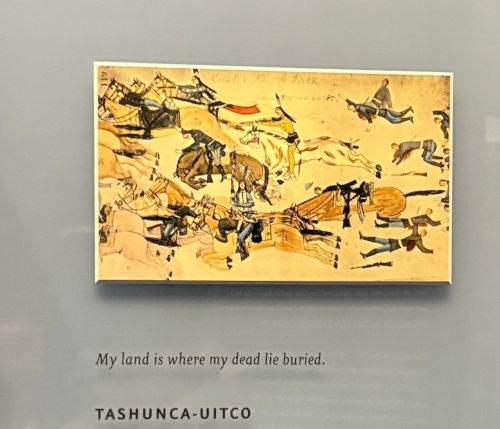
- Photo 4 - Stolen History - The Museum of the American Indian framed a quote from Tecumseh in a speech to his warriors encouraging them to unite in an Indian federation. “Where today are the Pequot? Where are the Narragansett, the Mohican, the Pocanet, and other powerful tribes of our people? They have vanished before the avarice and oppression of the white man, as snow before the summer sun…. will we let ourselves be destroyed in our turn, without making an effort worthy of our race? Shall we without a struggle, give up our homes, our lands, bequeathed to us by the Great Spirit? The graves of our dead and everything that is dear and sacred to us? I know you will say with me, Never! Never!” - Tecumseh, 1811
- Photo 5 - Metaphorical Death - This photo is from the Museum of the American Indian and illustrates how the death of a non-corporal piece of culture can impact a society as strongly as a human death. Death does not pick and choose who it takes but society influences how easily something is erased.
- Photo 6 - Home - From the Museum of the American Indian, I learned that land and ancestry can be interconnected to the point that to lose one is to lose the other. More than money, land can hold meaning to generations, but it depends on who you ask.
- Photo 7 - Honoring the Fallen - St. Paul’s Chapel appears untouched by time, preserving the memory of Revolutionary War veterans who lie amongst monuments like this one. Even the tragic destruction of 9/11 failed to decimate this small cemetery in the center of NYC.
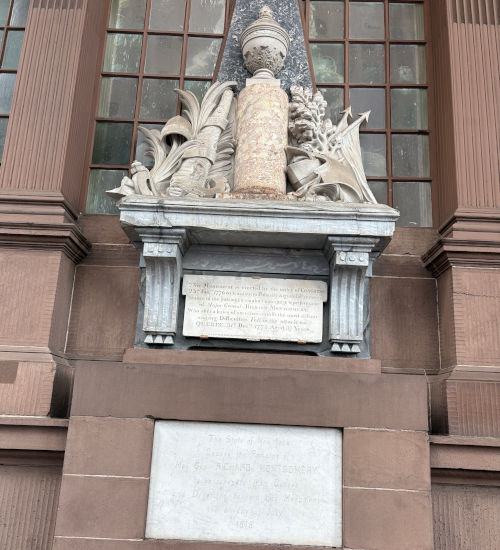
- Photo 8 - A Hero’s Farewell - The entrance to Trinity Church is adorned with the beginning of a memorial to Major General Richard Montgomery’s patriotism commissioned by Congress in 1776. It is continued inside the church as the front altar and takes up an eye-catching position.
- Photo 9 - Skyscraper of Old - The cemetery of Trinity Church houses many of New York’s wealthy founders, including the Astor family. They are featured among other industry magnates on an intricately carved memorial towering above headstones below.
- Photo 10 - In Memento Mori - From the MET’s exhibit featuring death comes a reminder to the living. However, as you have seen from this photo essay, this statement does not apply to everyone. Even in death.
Death, The Great Equalizer?
In the US there is an expectation that death is an equalizer -- something to conquer socioeconomic imbalance, racial disparities, gender divides, any manner of life’s tribulations. However, our review of death in New York City revealed that while death is a certainty, it does not occur equally nor are the dead remembered with equal respect and care. This photo essay explores the tension between death markers and how society has valued them over time -- examining their upkeep and the design of the markers themselves.
The growth of New York City meant an expansion from Manhattan, forcing remains to be relocated and stashed in neighboring boroughs. Eventually, as cemeteries filled up and families migrated from the New York area, some were forgotten as is the case of the Richmond Terrace Cemetery on Staten Island. The cemetery, whose inhabitants include Civil War veterans, a US president’s ancestor, and the family of a freed enslaved man, served as space for various activities over the years including drug dealing and sex work. The story of growth and final resting places is not new to New York. The land’s previous inhabitants, the American Indians, were introduced to the immediate devaluation of their dead when colonial settlers moved onto their lands, forcing tribes to abandon their ancestors. While not physical death markers, I include images from the Museum of the American Indian that illustrate the long history of tension between the monetary value society places on cemeteries and the cultural value it tends to ignore.
Following the images depicting the devaluation of death markers and the disregard for deaths in certain groups, I add photos of death markers society invested in and maintained forcenturies to create tension between the two groups of photos. In real life, this tension can be witnessed in the span of a subway ride, emphasizing how the geographical location of a final resting place can determine if it remains final. The last image in the series invites viewers to reflect on the juxtaposition between the sets of images and to question an age-old adage about death. For future analysis, the themes of modernization and object permanence displayed in this collection could be further explored through these images.